Year founded: 2013
Facilities: Clinics, Education, Partners
Main services: treatment of gum and periodontal tissue diseases, including consultation and diagnosis, prevention and hygiene, non-surgical periodontal treatment, modulatory techniques, surgical periodontology, and general surgery.
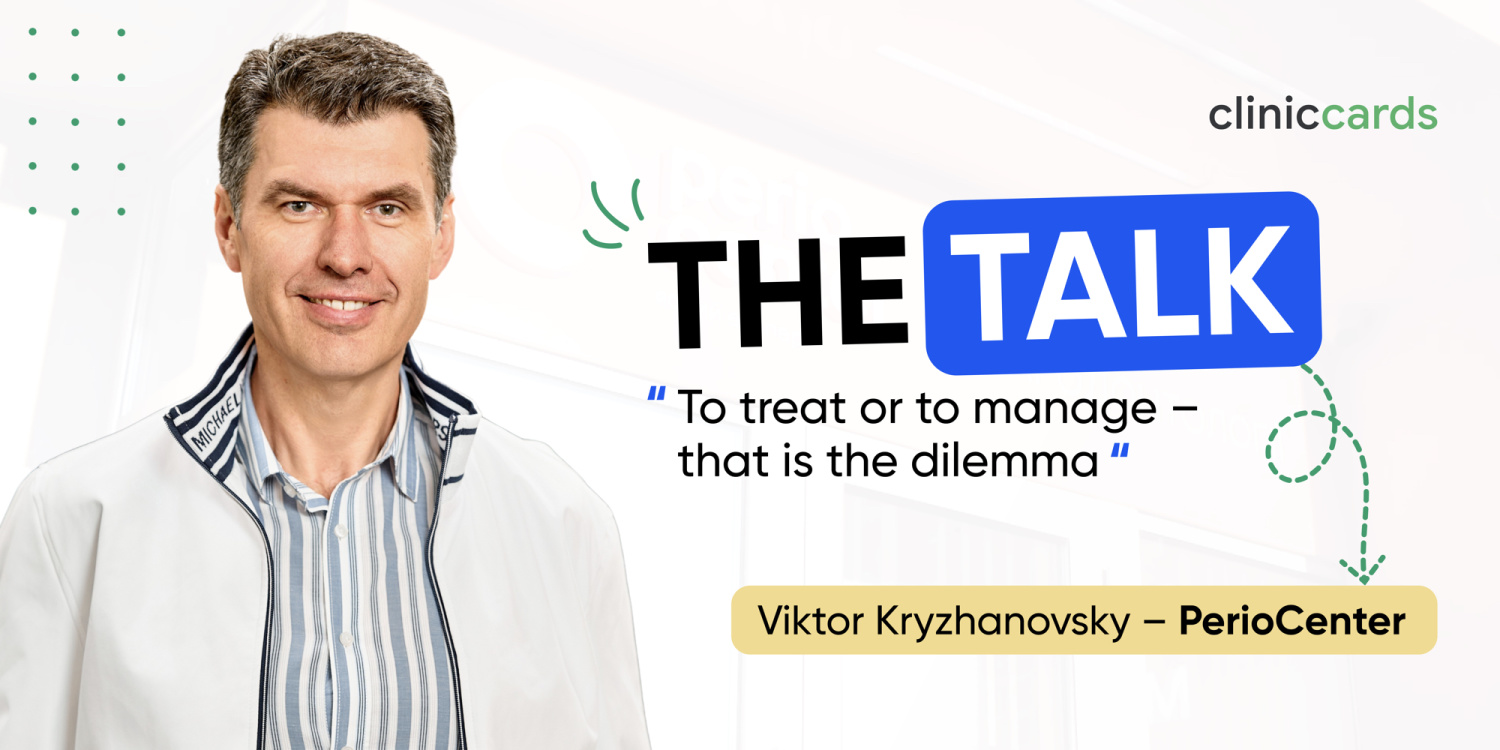
Today, we’d like to take a virtual tour of PerioCenter in Kyiv. We’re in for an interesting and in-depth conversation with the founder of the clinic – and now the company – Viktor Kryzhanovskyi.
What is PerioCenter today? What locations are part of your company?
Currently, PerioCenter consists of a clinic where we treat patients and a training center where we host educational events for both our employees and our colleagues. The training center has four stations, allowing four specialists to train simultaneously. Dental manikins are used to practice dental procedures.
So, you started with three treatment rooms?
Yes. Today we have two left, where the phantoms are already mounted directly in the dental chairs. And here we can work on ergonomics in greater detail. I believe that ergonomics is fundamental for a dentist. If a dentist sits incorrectly, they may experience pain in both their back and arms. That’s why everything is first practiced on phantoms, and then the phantoms are secured directly in the dental chairs. The final step is when dentists practice under the supervision of experts directly inside the patient’s mouth. This is our hybrid training model: theory is taught online, with homework assignments. Trainees study, review the theory, and then put it into practice. Depending on the training program, they either practice on each other or bring in a patient and hone their manual skills under the supervision of our specialists. Trainees do not practice on our specialists; instead, they work on the clinic’s patients.
Please tell us about the history of the clinic’s founding.
It all started with a single office that we rented 11 years ago. We split off from the general dental clinic “Eskadent,” which is now 21 years old. And if we go back even further, we’ve been active in the dental market since 1999. So we’re quite experienced, having worked for over 25 years. In 2013, we opened our first clinic, with two treatment rooms.
PerioCenter specializes in treating severe cases of periodontal disease – that is, diseases of the tissues surrounding the teeth and dental implants. This is our clinical focus. Today, we’re also developing our educational program.
We train doctors through a postgraduate program in periodontology. We start with oral hygiene – which is essential for all doctors – and then move on to periodontology. Another area we’re focusing on at the company right now is partnerships. We already have specialists with whom we work on a partnership basis.
Chief Physician Tetyana Domianenko will tell you more about the clinic.
Tetyana, it’s a pleasure to meet you :) So, tell us – how do you work with patients at PerioCenter?
I’m not only the chief physician at PerioCenter, but also a mentor and expert in periodontology. Here at our clinic, we specialize in treating periodontal disease.
Our friendly administrative staff greets patients at the reception desk. Next, the patient comes to the clinic and completes a health questionnaire. We also often send patients health questionnaires electronically so they can fill them out at home. Next, patients undergo either a CT scan or a panoramic X-ray. The next step is a delicious cup of coffee while waiting for the doctor :)
Periodontal consultations take place in our largest treatment room. Of course, treatment begins with an initial consultation. Next come the additional techniques we use in our daily practice: photodynamic therapy, plasma therapy, hyaluronic acid injections into periodontal pockets, vector therapy, and ozone therapy.
Who conducts the initial consultations with your patients?
Periodontists with extensive experience. We have mentor doctors who are responsible for training. We literally train our specialists. All our doctors come to us for their residency or as young specialists and start as assistants. They observe how a periodontal appointment is structured and conducted. If a person realizes they enjoy it, then we begin teaching them professional hygiene in greater detail. Next comes non-surgical treatment of periodontal diseases. Of course, a specialist needs to work for a certain period of time to gain more independence. We recently awarded certificates to our specialists because we truly value and love our brand. It’s important to us that everything is done to the highest standard.
Where exactly do surgical procedures take place?
In the surgical suite, of course. We use Cliniccards here :) We really love this program. It’s an indispensable tool in our daily practice. I can’t even imagine how we’d work without it.
We started using Cliniccards in 2019, and since then, our lives have been divided into “before” and “after.” Thank you for such an indispensable product! As the chief physician, it’s very convenient for me to monitor appointment availability – that is, patient scheduling. It’s very convenient to review the records to ensure medical documentation is being maintained correctly. We have specific criteria by which we review each record, such as photo diagnostics.
We’re always very happy to hear that :) Please tell us: do you review the records daily or weekly? How does this process work?
I check the records almost every day. When I have a chance between patients or, for example, when I have a few hours a day, I do it at work. But sometimes it’s more convenient to do it at home. If something is wrong, I can write about it right away.
Actually, the templates in Cliniccards – which our training center has already developed – are a huge help to us. It’s convenient for assistants to use them during appointments while the doctor is working, making adjustments to a specific template for a particular patient.
The clinic also has a staff break room and the chief dentist’s office. Interestingly, I’m not the only one who checks the charts here :) We also use this space to present treatment plans to patients, discuss findings after completing periodontal diagnostics, and conduct periodontal consultations.
That’s cool. Getting back to our conversation with Victor, we’d like to ask what’s probably on everyone’s mind: what inspired you to structure PerioCenter this way?
It all happened naturally. The company was growing, and we realized that what we do well with our hands, we could now pass on to others and share our experience. Then we realized we could also help businesses, clinics, and managers. And today we have over 80 employees (doctors, assistants, and the management company staff).
Obviously, managing all of this isn’t easy. Have you stepped away from medical practice entirely by now?
Yes, I’m not working with patients these days. Why “almost”? Because sometimes I have to talk to someone :) But I haven’t been working directly in the oral cavity for probably three years now. Today, my work is exclusively managerial. My company is like an extension of myself. All the employees, all the doctors – I feel as though they’re my own hands.
Don’t you miss practicing dentistry?
You know, no. How could I miss it? :) I can’t stick to the same thing for very long. I get bored and depressed. Over the course of my life, I’ve been a massage therapist, an X-ray technician, a dental technician, and a general dentist. Then I got into surgery: I placed dental implants and performed bone grafts. Then came orthopedics – treating patients with orofacial pain.
It’s like a game where I move from one level to the next. And so it happened that, at around age 50, I stepped away from clinical practice altogether and dove into management. For me, it’s like a second youth. I’m a young specialist again, and I’m learning all over again.
How did you draw the line between being a doctor and being an owner?
For a while, I was both a doctor and a manager. In 2013, I founded PerioCenter. Back then, I earned money as a dentist and invested it in my business – both money and time.
Over time, my clinical work decreased, while my management responsibilities increased. I've decided to focus on management and step away from my clinical practice. Why? Because we have a limited amount of time in life. And depending on where we direct our time, that’s where growth happens. Where there’s less time, there’s no growth.
There are so many questions surrounding the management of a medical business. Many physician-entrepreneurs who are considering opening their private practice find that, while they excel as doctors, their management skills aren’t quite up to par. For myself, I ultimately decided to focus on management. That was my choice. And today, I take pleasure in the fact that I can afford to do the work I want to do, rather than the work I’m forced to do.
Here’s the reality: a clinic is an entity that exists within a specific space. Doctors are physically tied to the clinic, as is the team. But as a manager, to what extent are you physically tied to the clinic? You can, in principle, work anywhere, right? Or does your managerial role require you to be here every day, constantly dealing with a host of issues? These are very interesting points.
Indeed, being tied to the clinic is often a painful issue. How do you feel about this?
A doctor always works offline. That has always stressed me out a lot. Many doctors call themselves slaves to their profession because a doctor is forced to be at the workplace all the time.
My father is a dentist, and his whole life he simply couldn’t understand how anyone could not treat people. In other words, there are people for whom this kind of life is comfortable, peaceful, and great. And these are real doctors, because they can’t imagine any other life.
However, the choice between treating patients and managing the practice causes great discomfort for such doctors. At one point, I was looking for a way to ease this pressure without constantly being “offline” from patients.
Today, I can work remotely for a certain amount of time. But not for very long, because after all, you need to be there in person; you need to see the people we work with. Face-to-face communication is more effective.
That’s really great. Would it be fair to say that you’ve already fully set up the business so that this system runs smoothly and effectively without you?
Yes, 100%. There’s a term – “bicycle business.” What does that mean? There are businesses where the person running the business is the one pedaling. But as soon as they stop, the business keeps going for a little while, and then it stops.
I believe that a doctor’s private practice is a “bicycle business.” As long as the doctor is there, the business keeps moving. As soon as that doctor leaves, the business keeps moving for a while, but eventually comes to a halt. But there are other businesses where the owner doesn’t have to be involved in every process – they can delegate them to managers or key staff members.
For now, I can’t completely step away from PerioCenter. I have a really great team of specialists and managers who are a huge help – in HR, finance, company administration, marketing, and sales. However, for now, I remain the head of this company.
In dentistry, a clinic is often associated with the owner, the central figure. Later, when it comes to delegation, a difficult question arises: how do you hand over what you’ve built to someone else? Do you have any advice on this?
I can only delegate to someone I trust. And trust isn’t built on words alone. It takes time to trust someone. The practice of building a company around the founding dentist’s name is very common. But I didn’t go down that path because I realized that it would be difficult for me to step away from the business later on. I’d already had the experience of my father being the central figure, with the clinic built around him. That’s why my “baby” is called PerioCenter. Now I have a team I trust and delegate to. I work at the department head level. And I see that everything is running smoothly, so the managers are doing a good job.
How can an owner successfully delegate? It depends entirely on the owner. Will he be able, as you say, to entrust his “child” to someone else? This is a very difficult question. And here, everything probably depends on the owner’s maturity. We, as people, go through certain stages of maturation: daycare, preschool, school, and so on. The same goes for business owners. At first, they’re just crawling; then they take their first steps; then they go to school; and then they mature enough to become true leaders or managers.
What do you think – can a doctor run a practice while also taking responsibility for other people, organizing them, motivating them, and delegating tasks?
A dentist can be a super-cool doctor and do an excellent job inside the mouth. But if they lack management skills, they’ll remain just a practicing dentist. That’s neither good nor bad – it’s their path. But management skills and experience – that’s a whole different story.
Doctors know how many years it takes to become a great specialist. Yet for some reason, they still think you can become a great manager just by reading one book or taking a few courses. I see that a great many colleagues suffer from this illusion: if I’m a great dentist, then automatically I’m a great manager. No, it doesn’t work that way. This is a very important point. If I want to become a great manager, I have to understand that I’ll have to follow the same path as when I was becoming a great dentist.
Where, then, can dentists gain direct management experience? Only within the field of dentistry? Are there other ways?
You need to find someone from whom you can learn and gain that experience. I was lucky. My father was a gifted dentist and had management experience. At one point, he was the director of a clinic. He understood how to communicate with people and how to handle paperwork. And the foundations he laid for the dental clinic – the first private practice – he established right from the start with a manager’s perspective: communication and documentation. I learned from him, which is why I was so lucky that after that there were experiences, books, and courses.
Today, I’m still learning. I’m over 50, but I keep learning – I never stop. I have a business consultant whom I turn to. He’s a more experienced person who helps me build my company. Because the knowledge I gained from my father, from books, and from courses is no longer enough. I suppose anything that doesn’t evolve eventually dies. And if I want to keep moving forward, I have to keep evolving and learning.
If a professional doesn’t have a mentor in their circle, what then? Who should they surround themselves with, with whom should they exchange experiences, or from whom should they learn?
I know many successful people who genuinely want to share their skills. But there’s no one to turn to. For those who truly don’t have a father figure or mentor, let me give an example. In Guy Kawasaki’s book *Startup*, I first read about the concept of the “inner entrepreneur.” In the book, this concept applies to IT companies: if someone wants to succeed in the IT field, they don’t necessarily have to start their own company right away, since there are already thousands of large companies. Such professionals can work within a company as an “internal entrepreneur” and build different kinds of relationships within the organization.
And if, for example, a responsible person joins my company – someone deeply committed to it – I want to partner with that person. I want to ensure this person feels comfortable here and doesn’t end up wanting to start their own company.
Today, our company has employees who have been with us for over 20 years. For example, our manager Olena joined the company as an assistant. Now she’s a division head and a very capable person. Anna, the head of the training center, has been with the company for eight years. And these aren’t isolated cases. If, as a manager, I see that a person is dedicated to the company, shares its values, and does everything to help the company grow, I will, of course, invest in them.
Sharing experiences is truly important. However, how do you feel about other approaches to work? For example, work-life balance?
Ron Hubbard explored the topic of exchange very well. I’m impressed by his ideas on building relationships with people. So, he describes four types of exchange.
The first is criminal, when someone steals something from someone else. Of course, this kind of exchange leads to the collapse of the relationship. The second is an unequal exchange: I give five but receive three. It also causes some discomfort in people. Next is an equal exchange: I give five, you give five. This is stable but doesn’t lead to the development of a relationship. And only an exchange with a surplus is the only way to develop a relationship: I give five, I receive six.
We’ve enshrined this in our corporate culture. When a new employee joins, we explain these types of exchange and say, “Look, the minimum is an equal exchange. But there’s an opportunity to grow within the company. To achieve that, you need to give more than you receive. But in return, you’ll also get more than we agreed upon.”
As for work-life balance, that’s already part of the company’s corporate culture: a company either chooses this kind of relationship with its employees or a relationship focused on growth. We’ve consciously chosen the latter path. We work with employees to figure out how they can earn more. I like this approach – it’s more than just getting a paycheck. That’s why we give 110% to our work, because 100% isn’t enough. So, work-life balance isn’t really our thing.
How do you determine for yourself whether a manager is an effective team leader or an effective employee?
I suppose that anything that isn’t measured doesn’t improve. In other words, we can measure absolutely everything. We establish specific criteria to determine whether the company is growing. Once we’ve defined these metrics and see growth, then it’s effective. In other words, everything a manager does leads to the company’s growth. And anything that stagnates or declines is a result of ineffective management.
Does Cliniccards help you with this? After all, we often have to explain to clinic owners or doctors that everything can and should be measured, recorded, and digitized as much as possible. What do you think about this?
There are a lot of people who are in the wrong line of work – they open their private practices without being prepared to manage them. And they operate purely on gut feelings. But, in essence, they’re simply in the wrong line of work. Life pushes other doctors into becoming managers, even though they weren’t born for it. They don’t understand the concept of numbers at all. You can’t teach such a person. They’re convinced they’re doing everything right. But most don’t even realize that.
Some people are born to be artists. Some are born to be doctors. And some are born to be (you won’t believe it!) managers. That’s why the ideal scenario is when a person does what they were born to do. Openness to knowledge, a desire to learn, and a desire to grow in this direction also matter. You can’t motivate someone if they aren’t ready.
When it comes to Cliniccards as a management tool, we’ve been working together for many years. And today, I continue to be an advocate for the brand. I wholeheartedly recommend Cliniccards whenever doctors come to me. The first thing I ask a doctor is, “Do you use Cliniccards or not?” Then we can speak the same language.
In my view, Cliniccards is a comprehensive platform that offers a great deal. And not everyone can even grasp the full potential that we, as managers, can utilize. Today, it’s a tool that truly allows us to monitor the quality of doctors’ work. If everything is set up properly and doctors are working according to established standards, it’s a very powerful quality control tool.
What are your most common or popular tools in Cliniccards? Doctors and owners review patient records and photos every day. Some people only look at reports.
My focus is on ensuring compliance with Cliniccards’ standards and medical record-keeping in general. I’m a manager and a leader, and we’ve agreed with the doctors: if you don’t provide me with the tools to protect you, then that’s your problem. If any issues arise, you’re responsible.
For me to help you as a manager, I need to have certain evidence and facts. These facts must be documented in this way.
There’s a specific standard: what must be in the medical record, what must be in Cliniccards in digital format, what must be printed out, and what must be signed. And my main task is to ensure that doctors and staff follow these guidelines. I constantly emphasize to both clinic staff who work directly with patients and to the doctors that everything must be done exactly as prescribed.
Who exactly on your staff oversees this work?
Of course, not me ;) Some chief physicians review how well a doctor performed, how thoroughly everything is documented, and whether it’s documented exactly as it should be. If something is missing, they follow up to ensure it’s completed. Only when everything is under control is everyone at ease. At any time, we can retrieve information from the system (or from paper records) and resolve issues. Believe me, they come up all the time. Issues only vanish for those who aren’t working.
Specifically regarding tools, I like to track the clinic’s workload. I estimate what the workload might be and what it actually is at any given time. I also like the calendar. I can see which doctors are available for appointments and who has open slots.
These days, I hardly ever use Cliniccards myself, but it’s a tool our staff, managers, the clinic’s chief physicians, and the CFO use constantly. They gather a lot of information from it, then organize and analyze it.
We’re glad to hear that we’re helpful even with simple things. Can you think of any other situations where Cliniccards has been useful?
For me, Cliniccards is actually a form of social pressure. Because if I do something, my colleagues see it. And if I don’t do something very well, what will my colleagues think of me? That’s why it’s such a great tool. I even experienced this myself when I was still working as an oral surgeon, and we introduced mandatory photography. I’ve always been very meticulous with patients and with my work as a surgeon – especially when it comes to suturing. But one time I caught myself doing this: I’d finished stitching everything up, but I felt the urge to review the photo. I looked at it and said, “No, I need to redo one of the stitches.” And I felt that social pressure firsthand. Because I knew my colleagues would be looking at my work. And that stitch didn’t look very good ;)
I believe people need to feel this pressure to become better. Of course, this works for those who understand what responsibility is, what it means to do good work, and what “I must” and “I’m obligated” really mean. For them, it’s a really powerful tool.
You’re saying some very important things. Things that are obvious to many, but which a lot of professionals forget.
In fact, this message needs to be conveyed to managers or executives. An ordinary doctor who comes to work just to clock in and go home will find a thousand reasons not to follow the rules: “I don’t have time,” “my battery died.” When we implemented these standards, everything was clearly defined in accordance with Cliniccards’ guidelines.
We also faced resistance from doctors. But they, in particular, should be the ones with a stake in the matter. You need to implement such rules in a company that, whether you like it or not, you have no choice but to follow them. And if you don’t, you’ll be fired. It’s that straightforward.
Because the photo protocol is just one aspect of the standard for what must be in a patient’s chart. And if I can’t ensure my team follows such simple instructions, then I’m probably in the wrong job. I’m not a manager. If I say something needs to be done and an employee doesn’t do it, that means there are certain problems.
A great many doctors don’t know how to influence, don’t know how to lead, and can’t get their team to do what’s necessary. This happens because, most likely, they’re not doing what they’re supposed to be doing. If you’re a doctor – treat patients. Don’t get involved in management. Stick to your job.
And that’s exactly why I need Cliniccards – a tool that can help synchronize everyone, establish a single standard for consultations and treatment, track this, influence doctors, and require them to work according to the standards.
That’s great. Thank you! And one last question: based on your experience – both past and present – what advice would you give to colleagues who are currently considering opening their own clinic or company?
The first question a doctor considering opening a private practice, business, or company should ask themselves is, why do I need this? They must answer this question honestly. Because if it’s to work less and earn more, then – at least for the first 10 years – that’s definitely not what it’s about ;)
And second, I’ve said this before, but I’ll repeat it: if you’re a doctor – stay a doctor. Don’t get into management. Find a company where you’ll feel comfortable, where you’ll be valued, and where you can grow. And treat patients. Why do you need this headache? Don’t get into this, because there’s nothing fun about it ;)
But if you’re an entrepreneur or a manager, then, of course, go for it – grow in that role. And you absolutely need to understand: the time I invest in something is the time I spend growing. If I’m a doctor 80% of the time and devote 20% to management, nothing good will come of it.
Don’t try to balance these roles, because whoever tries to balance them loses out on both. And that applies to many things in life.
Thank you so much for such a great conversation. So much awesome information!
Awesome. I’m really glad we got to talk. I wish your product all the best. It’s truly valuable to me, and I wholeheartedly recommend it to everyone I talk to. So thank you for being here.