Year founded: 1991
Facilities: 6 dental units
Main services: general dentistry, surgery, periodontology, preventive care, implants, prosthodontics, orthodontics, pediatric dentistry.
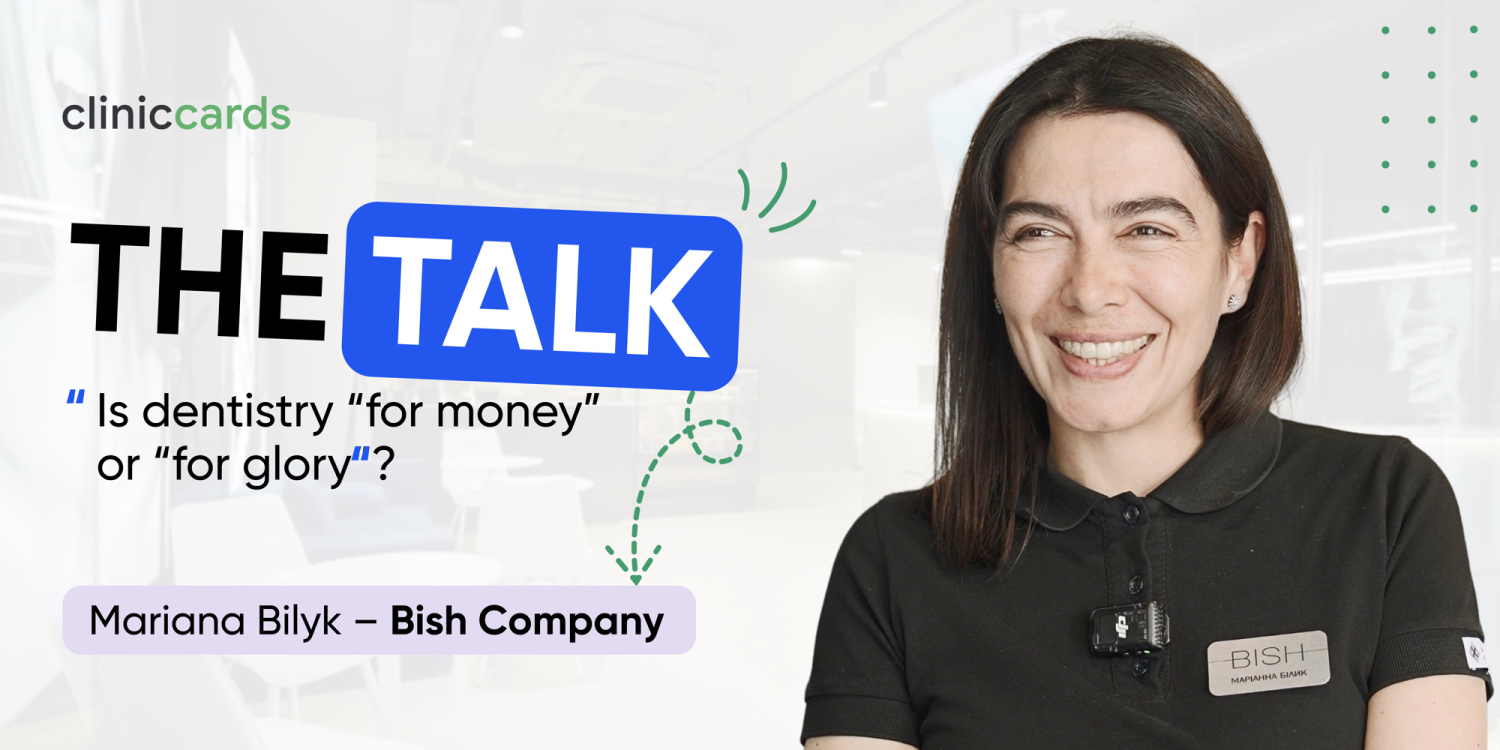
We continue our tour of dental clinics across Ukraine. What makes our blog unique is that we visit active clinics, and the owners and managers give us a behind-the-scenes look at their work and what makes it special. So today, we’ll be speaking with Mariana Bilyk, the owner of Bish Company.
Please tell us about the clinic and its history.
My father and a partner founded the clinic. We obtained our first license in 1989, have operated under the name Bish Company since 1991, and continue to do so today. Accordingly, the clinic is now 35 years old and has never changed its location.
In 2003, my dad built another clinic 100 meters from here, and I bought out his share. I’ve been managing it since 2003. At first, I was a managing partner, and I bought out his entire share about ten years ago. Since then, I’ve been the sole owner of Bish Company – the entire clinic and brand.
What does your team look like? How many chairs and providers do you have?
We currently have six locations and about 47 people. But that’s not just providers – it’s the whole team: administrative staff, support staff, doctors, and the operations department. I don’t understand how you can run a clinic with just two chairs. But some doctors are really good at it – they know what they’re doing ;)
How did you build such a comprehensive structure?
The clinic has had six chairs and six treatment units since 2003, when I took over management. I previously had a 600-square-meter space, for which I drew up a first-floor plan and intended to create 6–7 examination rooms.
Then a business analyst came to consult me and said, “Mariana, is this ‘for business’ or ‘for glory’? ‘For glory’ or ‘for money’?” I said, “This is a business; we have to make money.” He said, “Well, look: you hang your design on the wall, you enjoy it – it’s very beautiful. But in these 600 square meters, we’re going to fit 12 chairs to make money.”
He explained that we needed to use the entire space to the fullest. But if it’s “for glory,” then that’s a different story. There was a 100-square-meter hall and two-story offices with 6.5-meter-high ceilings. It was extraordinarily beautiful. But things didn’t work out with that space after all. Later, it was hit by a missile during the full-scale invasion. And now I realize that my clinic wouldn’t exist anymore.
What motivated you to take action and build here and now?
I got tired of just dreaming. We conducted in-depth interviews with our patients. We do these periodically, so we know exactly what’s important to them: where our clinic should be located along their travel route – parking, access, transportation, moms with strollers – everything. So we obviously knew what kind of location we needed, its size, and the space specifications. And we searched for the right place for three years.
When I started my MBA, it was already during the height of the war – September-October 2022. One of the modules was about investments, budgeting, and economics. I took advantage of this opportunity and my group (since we worked in groups) to run the numbers on my business idea. I suggested, “Let’s draw up an investment budget for the dental practice.” And ever since then, I’ve had it fully laid out: from expenses to profitability. I understand the optimistic, realistic, and pessimistic projections. That is, how we’ll operate, how long it will take for the investment to pay off, and so on.
So, the main thing is to plan out your dream as thoroughly as possible? Is there anything else?
Doctors often start “for money,” or rather “for glory,” or even simply because they want to do something. This is something I talk about quite often because I’ve been through it myself. My first 10 years of running a clinic were based on intuition. Those were my own, very costly mistakes. After that, I realized that for dentists with our education, the choice is just about this: be a dentist, be a dentist, or be a dentist. Everything else has nothing to do with our education.
Firstly, we don’t even know how to count money. Thanks to my husband, who pushed me to start preparing my first financial reports and projections, I began to understand this. I’ve asked many dentists, “What’s the clinic’s profit margin?” They reply, “60%.” I ask for clarification: “Is that 60% net income?” They say, “Well, yeah.” I ask, “How do you calculate that?” And they reply, “Well, I took the money from the clinic – and that’s already income.”
In other words, people don’t even understand the difference between financial statements and cash flow. These are different things. They have no sense of it when they start investing in a business. It’s as if there’s always money available, but when the question of buying new equipment comes up, they opt for a Chinese model for $1,500 or $2,000 because they can’t afford one for $10,000. The thing is, they can afford it, but they don’t realize it.
That’s why one of my first steps was to launch a small and medium-sized business management program at UCU in Lviv. And I realized that, as it turns out, there’s such a thing as strategy. Surprise ;) And it needs to be laid out in writing.
So we had a strategy, marketing, and human resources management. Our business is both for money and for glory. For example, there’s practically no staff turnover at our clinic. People mostly leave only to go on maternity leave ;) However, a little less than 10 years ago, five doctors quit at the same time.
How did you get through such a painful moment?
I was worried because it meant losing my money. It took us half a year to fully recover. But we learned our lesson. Business – and dentistry in particular – is built on people. Not on facilities, not on equipment. For example, I often hear complaints that the owner doesn’t allow the clinic to grow or won’t let them purchase new materials or use new techniques. That’s why our clinic is equipped with the most expensive, state-of-the-art equipment. We’re not in an ideal space right now – we have very little room – but when we bought a scanner, it was a Primescan. When we bought a microscope back then, it was the latest model. For teeth whitening, we use Beyond Flash. We now have a second scanner for our orthodontist – the Medit 900. Our CT scanner is a Sirona. And all of it is new. Expensive, but new.
Is your business and your team part of you and your family, or do you keep these concepts separate?
Let’s be honest: the times we live in also influence our attitudes. Before the full-scale invasion, I really enjoyed the balance between business and family. We used to take vacations four or five times a year. And at the same time, the business kept running. That’s when I realized that business isn’t just about walking out of the clinic and having it stop working.
Now, during the full-scale invasion, you understand that conditions have changed. I fully understand the “but I have a family” perspective. But for me, for example, I’m currently spending more time on volunteer work and trying to drive systemic change in the country. I want to apply my business experience to the systemic level of government because I know I can.
Does Cliniccards help your business and meet your needs?
In terms of management, I’d say 75%. There’s room for growth, and that’s great. Because if you stopped developing it, we’d be looking for another CRM ;) Because the world is changing – demands, needs, and even our country’s requirements are changing drastically every month. I think every year – for sure. And we have to keep up with that.
Do you remember what you wanted to achieve when you acquired a stake in the clinic and when you started managing it? And were your expectations met?
I was 21 back then. It was summer, August. But I felt terrible because my dad had just moved to another clinic with most of the team. I didn’t have any doctors – just old equipment, old furniture – and nothing was working properly.
When I started, I didn’t understand what it meant to manage a clinic. I had just graduated from university and started my residency. And while my friends and classmates were going on vacation, I was going to work. Everyone was out having fun, and I was at work. I’d been working since my junior year. But I knew absolutely nothing about running a clinic. I went through it all: tears at staff meetings and shouting matches. And I had to go through all of that. If it hadn’t been for that, I wouldn’t be who I am today. So it’s all experience, and I’m also grateful for it.
Did I achieve what I wanted? I didn’t even imagine what that “what I wanted” was ;) At first, I just dove headfirst into work. If something didn’t go as it should, I’d take a step back and start over. It’s like with a samurai: you can’t knock him off course because he has no specific goal. He only has the path. That’s how it was for me.
But my strength is that I love learning all the time. I was constantly taking courses; I already have over 130 different certificates. My approach is this: as soon as I see something interesting, I try to implement it. I didn’t wait for tomorrow, later, or “someday.” I immediately investigated how to test the idea and gain practical experience. It’s important to note that I don’t jump on marketing bandwagons – I focus on evidence-based medicine and evidence-based practices.
You mention your dad a lot. Tell us more about him. Maybe there’s something about him that still inspires and motivates you.
First of all, I have a very similar personality. And since I’m the oldest in the family, he probably raised me like a boy. But he always taught me that, as a woman, I need to be able to earn enough to support at least myself and my children. So options like “marrying well” or just being pretty weren’t on the table for me.
Second, I wanted to become a criminal defense attorney or a prosecutor. But he said, “You’ll finish dental school, and then you can go wherever you want.” However, I was lucky – I actually ended up loving dentistry ;) Although, to be honest, I don’t think my dad’s approach to choosing a future career was entirely right. Still, I’m grateful to him for it.
What else inspires me? My favorite thing he used to say: “If you don’t have your opinion, it’s like with transportation: if you don’t have your car, you’ll have to use public transit.” He always had his opinion and his stance. His stance was proactive and pro-Ukrainian, even if it negatively affected his personal interests. That’s why it’s my stance now, too.
He knew how to enjoy life. Some people say, “Oh my God, what a shame he died at 53.” But I realize that he lived a life that some people wouldn’t live even in 103 years. Once, on a Thursday evening, he and Mom were at a party somewhere, and Dad said, “Let’s go to Crimea first thing tomorrow morning.” And Mom was like, “Let’s do it.” And by five in the morning, they were already on their way to Crimea.
So, were you inspired by that drive, that adrenaline rush?
Yes. We don’t know how long we’ll live: 50, 80, or 100 years. You have to live every day as if it were your last. And then, maybe, you’ll enjoy life and definitely live it to the fullest. I remember during the first revolution – I was still a child back then – on the very first evening, he was packing our things, asking friends about buses, driving around, collecting money, and filling up those buses with fuel because people were heading off to the revolution.
I feel like right now is our time. I actually believe that this is our war, not our children’s. Our parents stood their ground to a certain extent. We got what we got. We won’t debate whether it’s better or worse, but we have what we have. And we must take responsibility for what we’ll leave to our children. That’s what really matters.
But who is Mariana as a person? She’s a leader, a public figure, a doctor, and a mom. After all, you’re a practicing physician. How do you juggle so many roles?
I just don’t choose just one role. Why can’t you balance them? If you’re tired of being a clinic owner, you switch to being a wife and a mom. If you’re fed up with family life – sorry, but that happens too – you go back to work as a doctor. Don’t be afraid to switch roles. But do it wholeheartedly and do it well.
That’s cool. Now tell us about Dental Front. After all, that’s your main role. How did it all start, what’s it like now, and what are your plans?
Starting February 24, I spent the first three months working at the warehouse as the head of the medical division, overseeing medical operations. We had massive volumes: a 9,500-square-meter warehouse and about 3,000 medical items. It was an entirely new role for me: putting things away, keeping track of inventory. But paperwork and record-keeping aren’t my strong suits at all. I was lucky that a team from NOVA joined us at that time. Warehouse managers, logistics staff – everyone switched to volunteering. And thanks to them, we were able to get the real work started. They taught me how to organize goods on the shelves, how to monitor them, and how the warehouse inventory system works on such large projects and at such a scale.
At that time, I was president of the Ukrainian Association of Implantologists. By the way, when I stepped down as president, on February 24 or 25, 2022, we convened the board and decided to transfer 100,000 UAH from the association’s account to the Armed Forces. Those were the first days of the full-scale invasion. In other words, we were doing everything we could to support the Armed Forces. And we continue to do so.
During that period, we also launched the Together.ua project: people bought sets of bracelets for 150 UAH each, and we raised funds for medical supplies for the troops. We raised over 100,000 UAH specifically for medicine for the troops, which was distributed among military units.
Since 2014, I’ve been working on the “Sanation” project: a clinic at the training ground where we’d go with the dental clinic once every two weeks to treat service members. In July 2022, I decided it was time to revive the project. After all, my primary field is dentistry. And I’ve always believed that when people do what they do best, the results are the highest quality.
I realized the process would be a long one. It took us a year to find a space and get the clinic up and running. We partnered with government agencies – the Novoyavorivsk City Council allocated a space for us and carried out the renovations. Thanks to Arina from TDS Dental, we held negotiations with the Americans. A-dec donated a new dental unit to us. TDS Dental purchased the second one. We raised funds from everywhere. Inspе got involved and provided us with some instruments, materials, and equipment. Galit provided us with a compressor and other equipment at cost.
And so, through our joint efforts, we launched this first clinic a year after the idea was conceived, in July 2023. It is still operating successfully. We have now launched a second clinic, incorporating all the lessons we learned from the first. It is located at the 199th Training Center of the Airborne Assault Forces. We are currently revising the regulatory, material, and technical framework, as well as the staffing structure, to clearly explain to the unit’s leadership exactly what is needed for the dental clinic at the military training center to operate effectively – including the necessary equipment, such as panoramic X-ray machines.
Do you use Cliniccards there as well?
These clinics provide care on par with private clinics: cameras, Cliniccards, and all treatment is by appointment. Cliniccards will be used there a little differently – without personal data – for monitoring, understanding the volume of work, and patient record-keeping.
In fact, we have many such divisions. We work with many military dentists and veterans. Once, we were approached by a center that treated military personnel with amputations. That’s how we got started. Currently, we’re also working with Superhumans and planning to work with Unbroken as well. So we’ve limited our assistance exclusively to military personnel with amputations.
So why dentistry? You already know how to do so many things. Why aren’t you doing something else?
I say, “Let me do proctology, and let a plumber handle dentistry.” I do what I do. What I’m capable of. That’s why I think it’s natural, right, and shouldn’t be underestimated.
It’s generally very difficult to offend me. But in a chat room, when I said we were working on dentistry and implementing changes, one dentist wrote, “Well, let the women have their fun while we’re doing real work.” And the most interesting thing is that no one – absolutely no one – in that chat room said a single word to him in objection. Everyone stayed silent. That, too, is a weakness in our society’s stance.
In reality, we still have a long way to go as a society. And as a nation – even more so. You know, Hrytsak said it really well: a people is like self-sown grass, while a nation is like a neatly mowed lawn. We still need to learn how to be a nation.
Have you had any screw-ups? Anything you’ve done wrong recently that you regret?
I see every screw-up as a learning experience. But an “epic fail” is when something didn’t work out, you failed, and you didn’t learn anything from it. That’s when it’s a waste of nerves, effort, and resources.
Once, we launched a call center, and it didn’t work out. We recruited administrators for it; there was a trial period, but the girl didn’t like it, so she quit. Now that construction of the new clinic is underway, we don’t have time to look for additional administrators. So our call center is sitting idle. Consequently, the receptionists are bearing the brunt of it.
That’s why I always say: we don’t have external marketing – we have internal marketing. And for now, we can’t afford external marketing because we won’t be able to schedule patients. There won’t be any openings to schedule them for. Once we open, we’ll definitely move into external marketing. But we’ll do it differently – our own way.
How do you feel about social media?
This is the kind of external marketing we’ve never had. I understand that clinics entering the market for the first time need to make their presence known somehow. But I really want to maintain a balance between the medical profession, the business, and the patient. In other words, we don’t let the patient control the treatment process. We’ve simply been through a lot at the clinic. There have been times when a patient comes in and says, “Pull my tooth.” I say, “Okay.” But the decision to extract a tooth isn’t made by the patient. It has to be a medical decision. The patient may have their wishes and requests, but they can’t dictate the treatment process.
It’s the same with marketing. We can’t do everything just to please the patient if it undermines the medical profession or creates unrealistic expectations.
So it’s important to you that marketing doesn’t devalue the doctor?
Yes. And that it doesn’t upset the balance. Because a clinic isn’t just a business; it’s medicine. There’s responsibility involved – there’s the doctor, the patient, and the treatment process. And all of this must remain in balance. I understand that marketing is necessary. When we open a new clinic, we’ll have to talk more about ourselves. But it won’t be a story about dancing, goofing around, or some silly videos. I don’t want a doctor to look like someone who has to entertain the patient just to get them to come in for an appointment.
How exactly do you distinguish between internal and external marketing?
Internal marketing involves working with patients who are already visiting our clinic. External marketing is when we want to convey something to the outside world. But this isn’t about branding – that’s a different story.
We focus heavily on internal marketing, tailoring it to include unique touches and a “wow” factor patients don’t expect. We have numerous plans ;) We draw some of our ideas from the hospitality industry because the hotel business really knows how to deliver great service.
I’ve noticed that patients generally can’t evaluate the quality of a service. They either feel comfortable or they don’t. You can’t really tell whether your root canal was filled properly. You just either feel pain or you don’t.
It’s like that meme where the doctor says, “If it hurts, scream,” but the patient is screaming at the front desk? ;)
Something like that :) That’s why, for us, internal marketing isn’t just about selling something to a patient or “advertising.” It’s a system. And if the system isn’t ready, it’s better to build it out first. To create an experience where the patient understands where they are, what’s happening to them, why it’s being done, and feels comfortable going through the process. We’ve never equated ourselves with a store, a movie theater, or an entertainment center. I want to make this my guiding principle. I’m all for maintaining the professional standards of dentistry and making it clear that a dentist isn’t an entertainer. A dentist puts in a tremendous amount of effort.
Finally, I’d like to ask: what inspires you the most right now?
Foremost, my business. I have one fixed day at the clinic – Tuesdays. Everyone knows – people sometimes write on Facebook, “Where are your Stories? Aren’t you at the clinic?” I really get a kick out of it when I arrive at the clinic and perform surgeries. I’m in my element there.
And second – it’s when I go to the front lines. It’s very exhausting, but I understand why I live here, why I have the right to work here. Because the soldiers are out there – in the mud, in the cold. Tired, sleep-deprived, risking their lives, they stand there and give us a chance to do something here.
That’s why every day, this is what lifts me up and keeps me from giving up.
Even with broken wings, keep moving forward.
What advice would you give to doctors who are just starting to set up a clinic?
Count everything. Count the money, the budgets, the future, and the expenses. Everything. And I think it’s very important not to be afraid. There will be failures. Everyone has them. Everyone makes mistakes; every businessperson does. But don’t be afraid. Get back up every time. Once, twice, a hundred times – get back up. And it’s very important to build a support system that will lift you up, not clip your wings. That’s significant.
Thank you so much for the conversation. I’m sure it will interest our readers. And even if it helps just one person, that’s already great.