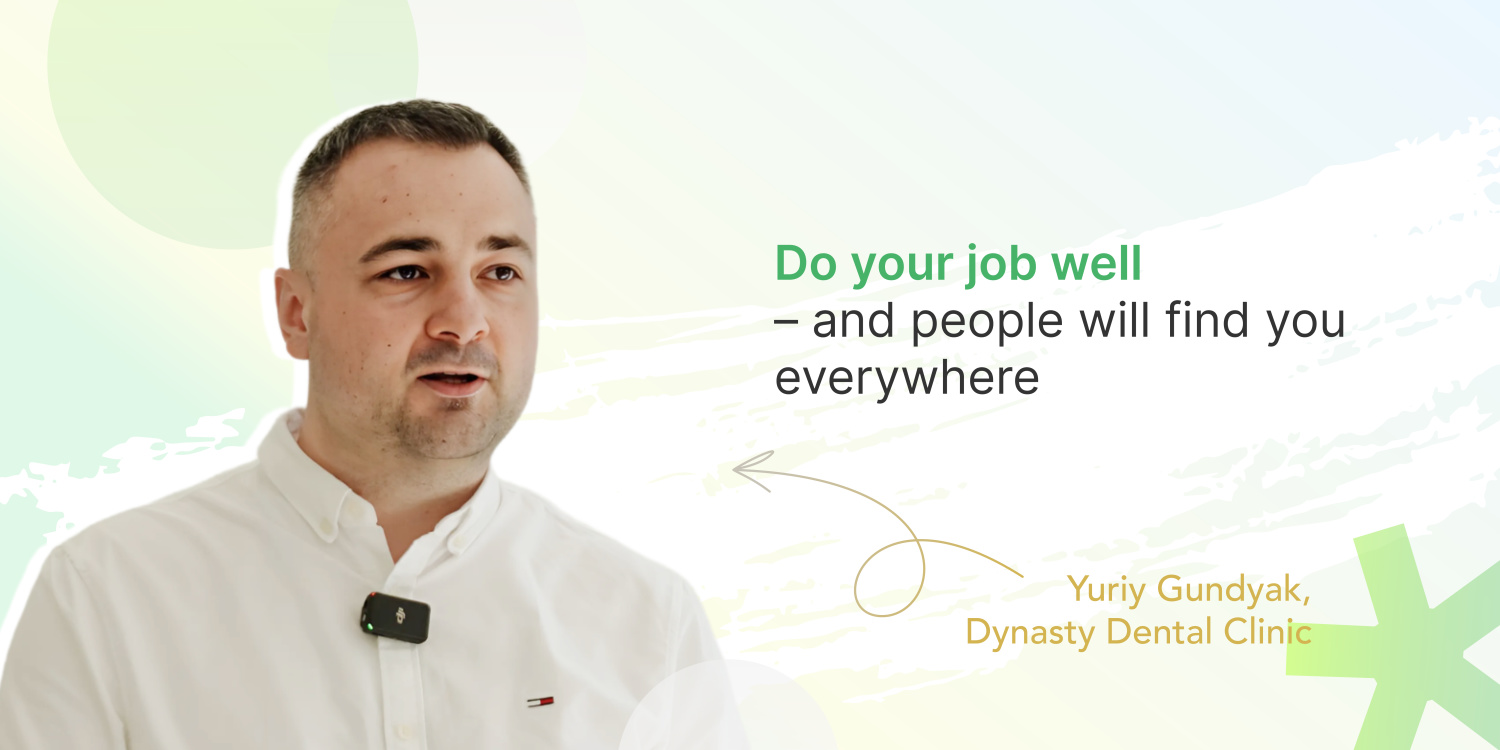
The Cliniccards team loves to travel, and today we want to share our special trip to Yaremche to chat with Yuriy Gundyak, the owner of Dynasty Dental Clinic.
We discovered how a once-small dental clinic found inspiration in Italy and evolved into a modern business for people and about people.
Tell us about the clinic and its history. Why Yaremche? And how did all of Ukraine find out about you?
Actually, it’s all very logical. I’m a native of Yaremche myself. I was born and raised here. I tried many different businesses and locations, but I still came back here. It was here that I realized: if you do your job well, people will find you no matter where you are. Now that’s my life credo. If you create the right conditions so that patients can receive treatment and relax, you’re sure to attract more patients.
So those very conditions in this city – is that your secret?
Yes. Here we have banosh, brynza, deruny, mushrooms – all of this is one of the secrets to the success of Dynasty Dental Clinic :) The mountains. The healing air. To be honest, we tried working in Kyiv, in Dnipro, and abroad. I worked in Vienna for two years. I saw how things should be done and picked up some new tricks, new approaches to service and communication with clients. But eventually, I realized that my place is here. Why? Because most of our patients started coming here.
So, would it be correct to say that your patients are tourists?
No, actually, not quite. At the beginning of our story, all our patients were residents. But there aren’t many of them :) Yaremche has a population of 8,000. And we already know the locals, and they know us. And we can’t treat the same patient twice. Eventually, we’ll cure them anyway :)
How did you find patients outside Yaremche?
My mentors in Italy helped me a lot with this. They were the ones who suggested that we invite top specialists to collaborate with us. At first glance, it seemed like such a risky idea. But over time, we realized that something amazing was happening when top specialists agreed to come to us. And when I saw how they interacted with patients, I realized that a team is the path to success. Not the walls, not the ambiance, not the fancy gadgets. That’s what makes a successful dental clinic.
That sounds very intriguing. You invited specialists – they agreed to come. But you must have lured them with something, right?
The first specialist to join us was a surgeon whom we invited for just one procedure. And, naturally, I soon realized that the number of patients for this kind of work was growing. The next specialist was an orthodontist. This young woman simply came to us for orthopedic training courses around 2016. We were talking one day, and I said, “Listen, we don’t have any orthodontic patients. We seem to solve everything orthopedically. Orthodontics isn’t effective. We just cover it all up with veneers.” She says, “I’ll prove you wrong.” So I showed her our patients. She said, “This is orthodontics, and this is orthodontics, and this too.” I said, “Okay, come visit us after the course.”
So, it was the patients who actually lured this specialist to you? :)
This doctor is from Kharkiv, and we hadn’t planned on starting a business project. She came to see us and spent the whole day with us. I couldn’t even have imagined it, but all the patients really did need orthodontic treatment. And it was only after talking to her that everyone agreed to treatment plans, even though we weren’t working together yet. That’s how this project was born, and it continues to fuel our progress to this day.
What was the most challenging part of developing the clinic for you?
Logistics. Our administrators handle this – they have to gather many people in one place at the same time. They coordinate doctors’ schedules, patients’ appointments, accommodations, and follow-up visits.
It’s great that you keep saying “project.” So your clinic is really about interaction and collaboration. Did you have, say, a business plan? Or were all the details decided on the fly?
We used to have two locations in Yaremche, where general practitioners – doctors who did everything – worked. And that was also a turning point, because transitioning from a model where all doctors perform every procedure to one with narrow-profile specialists is extremely difficult. My main goal is for every doctor to get the most out of their work. That’s how we improved the quality of care while eliminating internal competition for patients. No matter which patient comes to the clinic, they’ll be treated by the right specialist.
How does the initial consultation take place at your clinic? How do you develop a treatment plan and motivate the patient to follow it?
There’s a whole concept here that I adopted from my mentors – Domenico Massironi and Carlo Ghezzi. At Carlo’s clinic, all specialists are referral-based, and patients come to them from all over Italy. Yes, it is one of the most expensive clinics in Milan. But we gave it a try, and their concept worked for us.
I try to see all new patients myself. Because, in my opinion, it is the orthopedist who should perform the initial diagnosis and initial examination of all patients. Because the orthopedist is the logical culmination of any dental treatment. Whether it’s implantation, orthodontics, or therapy? Thereafter, it’s often necessary to place a ceramic restoration.
So, is that how the patient’s main problem is determined?
Yes, because I know that any narrow-profile specialist, for example, a general dentist or an endodontist, will draw up an endodontic treatment plan. A restorative dentist will draw up a restoration plan. That is, they might briefly examine the orthopedics and indicate that a crown is needed on this particular tooth.
But a specialist in a narrow field is unlikely to notice issues with the joint, the muscles, or pathological wear. Therefore, in my opinion, a treatment plan should be drawn up either with an orthopedist, with the orthopedist’s involvement, or by the orthopedist.
So the orthopedist and the administrators are the main people at your clinic? :)
You could say that :) As a rule, all patients book appointments with us via social media or by phone. And the administrators need to organize their logistics. We collaborate with travel agencies that offer certain discounts for our patients in Yaremche. If a patient has traveled from far away, we immediately schedule their next visits. The administrators handle all the scheduling. And yes, I know that we have an 80–85% approval rate for initial treatment plans.
Eight out of 10 agree to the full course of treatment and complete it. That means 60% proceed to a comprehensive treatment plan. What’s the secret?
It’s that patients come to us prepared. I put myself in that patient’s shoes and ask, why should I travel to a small town just to get my teeth fixed, for example? There has to be something that makes them get in a car or on a train and come here for treatment. Something unique. And we try to create that uniqueness.
Do you have any kind of referral program for patients? For example, discounts for referrals?
My wife and I (since she’s the clinic director) launched a program that gives every patient an electric toothbrush. After two years of this project, all our patients have electric toothbrushes. And that’s something truly unique. It’s cooler than standard discounts or classic SMM for dentistry. Because the feedback is great — patients post stories: “I came in for a cleaning, and they gave me an electric toothbrush!”
Now to the main point: how does Cliniccards help you?
Treatment plans, price lists — everything is clear and simple. Everyone understands what work needs to be done, which fillings to place, which teeth to extract, and what kind of specialist consultation is needed. Cliniccards has become an indispensable system for us in managing the dental clinic, communicating with specialists, and coordinating the team’s work. Today, we don’t communicate with administrators as much as we used to. We avoid that kind of micromanagement.
And regarding patient cards: do you add photos and other information? Do you check them personally, or do you rely on trust?
I check all notifications every day. Today, Cliniccards has become the clinic’s internal system for communication and quality control. Everyone understands this is a huge responsibility because they see your work. I am not allowing any private profiles or restricted access. Once, a doctor came up to me and asked, “Can I prevent other doctors from seeing my work?” To which I replied, “Hold on — do you have something to hide? Because if so, then we have a problem.”
How did you resolve this situation?
We create presentations for patients and send them via Viber. They include a photo report of everything that was done during the treatment.
Transparency has become part of our clinic’s culture. That’s why I always say, “Guys, do your work in a way that you won’t be ashamed of.” Because at first, people would say, “What if other doctors see this?” I say, “Yeah, great — they’ll see how well you work.”
How do you maintain the clinic’s work atmosphere?
My opinion is this: a successful dental clinic starts with a stable team. Our secret is that we’re all very good friends with the staff who come to work with us. We socialize with them outside the clinic. We discuss clinical cases and decide on treatment options. We’re constantly having conferences, meetings, photo shoots, and other events.
There was a situation where Myroslav Yuriyovych [Solonko] had a patient I wasn’t involved with. I said, “Let’s call our orthodontist.” We connected their clinic with our orthodontist and resolved the issue online. That’s exactly what makes you love your job. And when I see the sparkle in the doctors’ eyes, I realize my mission is accomplished, because they genuinely enjoy what they do.
What else makes your clinic unique?
We always have two specialists in each field: two surgeons, two general practitioners, two endodontists, and two orthodontists. And it’s not because I’m worried about losing someone. It’s because they constantly challenge each other. It’s healthy professional competition and continuous growth.
And the same goes for the nurses.
We don’t have a nurse assigned to a specific office. Every day, a different nurse works with the doctor. All nurses are competent in all offices. Everyone has the right to take a vacation; they have the option to take sick leave if the situation requires it. And the clinic won’t stop operating even in force majeure situations.
How do you gain a patient’s trust?
When I was in Milan in 2014, I saw six treatment units at the Carlo clinic, and accordingly, a different doctor at each one. I observed those consultations where, when a patient arrived, the doctor didn’t immediately start treating their teeth. He explains, shows CT scans, and illustrates periodontitis. He shows similar cases and the healing time. And this presentation lasts 5–10 minutes. By then, the patient trusts him so much that they realize this is top-notch care. The patient is ready.
I like it when a patient has a clear treatment plan, which we print out using Cliniccards, and understands all the stages of dental therapy. And they also see the fixed cost of all procedures. That way, all patients know that the cost of treatment won’t be higher than what’s specified in the plan. It might be lower, but not higher.
Why do you think your project has been successful? How do you motivate yourself? As a doctor, as a businessman.
My success is my wife. She took on the entire organization: logistics, finances, business development. I only deal with the specialists. To be honest, I don’t even know how much our services cost :) We used to work separately — my wife was working on another project, and I was focused on dentistry. There was no structure either way. Why? Because when I was organizing courses, I was simultaneously seeing patients, taking calls, and scheduling course participants and patients. It was complete chaos across the board. I couldn’t see the funds that could be accumulated. Now everything is simple: I handle the doctors, and my wife handles the system.
And Cliniccards has become an important part of our dental clinic’s development and the automation of our internal processes. We appreciate your work and look forward to communicating with you on our future projects!
The full video with Yuriy Gundyak is available for viewing at this link.