Year founded: 2021
Facilities: three modern dental offices
Main services: general dentistry, surgery, prosthodontics, orthodontics, dental implants, cosmetic dentistry, pediatric dentistry, and professional dental hygiene.
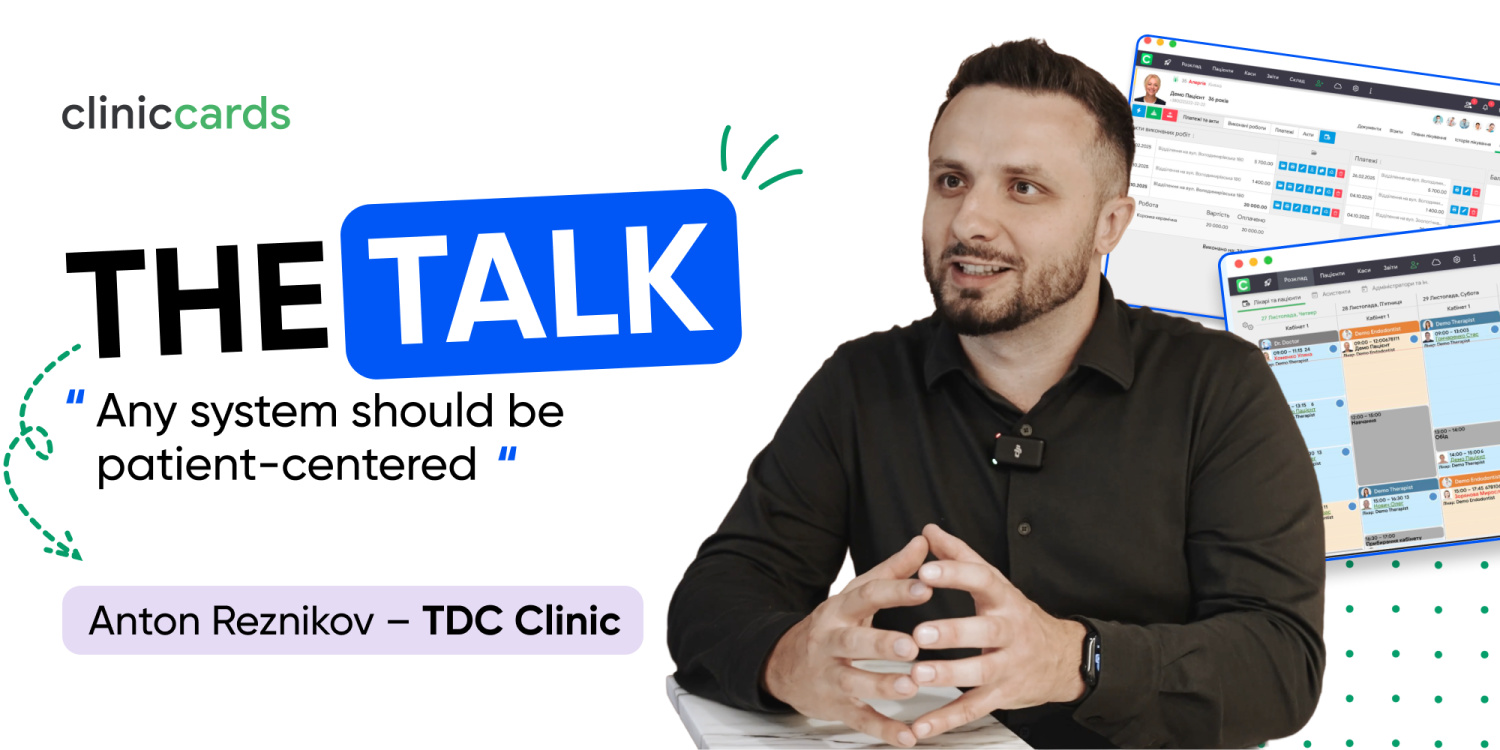
Dental clinics operate because people attend them. This truth is simple and straightforward. However, it’s important to understand that a clinic’s primary goal is to take care of the patient in such a way that they return. That is precisely why the Kyiv-based TDC Clinic has built patient care into the very foundation of its philosophy. We interviewed the owner, Anton Reznikov, to find out what a “boutique clinic” is, why a patient shouldn’t be seated in the dental chair right away, and what the “sacred stage” is.
First question. What exactly is a boutique clinic? These days, many people say, “We have a boutique clinic,” but not everyone understands what that means. Please explain.
Tell me, was it easy for you to find us? And was it easy to get here? That’s one of the first elements of the boutique concept.
We can’t be right on the main street or in a place where people stumble upon us accidentally. There needs to be a certain intimacy, coziness, and sense of privacy. At the same time, we’re located in the historic center of Kyiv. We even checked on Google — in fact, this is one of the most centrally located clinics in Kyiv relative to Independence Square. But at the same time, we’re quite well hidden.
But that’s not the only factor that defines a boutique clinic. What else is included in this concept?
In addition to the location, parking is very important. Our patients should be able to pull in easily, park their car safely, and not have to worry about it during their treatment. If someone arrives in an electric car, they can plug it in and charge it while they’re at their appointment. These are elements of service, comfort, and a premium approach to patient care. When it comes to the clinic itself, treatment is often a challenging process — especially when it lasts half a day or even a full day.
People need to rest and take a break. It’s uncomfortable to rest in the treatment room. Just walking around the clinic isn’t the best option either. But when you can grab a cup of coffee or tea, step out into the courtyard, take a break, or work on your laptop — that’s a whole different level of comfort.
You were one of the few clinics in Kyiv that hardly stopped working at the start of the full-scale invasion. Is that true?
Yes. Starting on the third day of the war, we began seeing patients and were one of the first dental clinics to resume operations. For the first two weeks, we worked for free. We provided care to everyone — the elderly, military personnel, civilians, journalists, and people of all income levels.
At that moment, it was an entirely natural decision. In terms of numbers, there are about two thousand dental clinics in Kyiv. At the start of the war, only about ten were actually operating. That’s less than one percent. We worked from morning until night. But most importantly, we didn’t lower our treatment standards. Everything remained the same as it was before the war: treatment under a microscope, adherence to all protocols, and high-quality care. That’s one of the things I’m truly proud of.
How are the clinic and its interior organized?
At the reception desk, we greet patients, schedule their appointments, plan their visits, and oversee the entire treatment process. A team of administrative staff works here. They manage the providers’ schedules, assist patients, and handle all organizational matters. This is also where patients can relax comfortably or wait for their appointment to begin. For our clinic’s format, this space is more than sufficient.
Why TDC Clinic? What does the name stand for?
It’s actually an abbreviation for True Dental Care. In fact, that’s our philosophy — genuine care for dental health and for the patient. The name is quite long, so we shortened it to TDC, but the philosophy itself hasn’t gone anywhere. It’s present in every interaction with a patient and remains the foundation of everything we do.
And how exactly do patients experience this care? How does it manifest in practice?
It actually begins even before treatment. For example, the entire courtyard we just saw is equipped with heated floors. In winter, there’s neither ice nor snow there. This means patients can safely enter or leave the clinic without risking a slip or a fall. It might seem like a small thing. But it’s precisely these small details that make up true care. At first, I did this simply because it felt like the right thing to do. But then I realized that patients notice and appreciate it.
Another very important aspect is the atmosphere. Most people are afraid of the dentists. Often, this fear stems from childhood: the smell of a hospital, green walls, tile. All of this evokes certain associations. Our first goal was to make sure people didn’t feel like they were in a medical facility. And that’s one of the reasons why we call ourselves a boutique clinic.
Can you give a specific example of how you care for your patients?
Yes, there was one very memorable situation. After sedation or major surgery, a patient must be picked up by a family member. A relative, friend, or acquaintance. After sedation, you’re not allowed to drive for 24 hours. And once, the person who was supposed to pick up the patient was unable to do so. The patient would have had to wait a long time at the clinic. Of course, we could have called a taxi. But to us, that didn’t seem like enough care. A person is in a vulnerable state after sedation. So our head nurse got into a taxi with the patient, accompanied him home, walked him into his apartment, and waited for the person who was supposed to look after him from there.
In reality, this represents a minimal investment of time or resources for the clinic. But for the patient, it means a great deal. When he finally came to his senses, he realized just how important this assistance had been. And he thanked us sincerely for not leaving him alone.
What is the foundation of your philosophy?
Our patients know that TDC Clinic isn’t just a name. It’s a philosophy of care. When children bring their parents to us or pay for their treatment, they’re confident that we’ll take care of them. If a person starts to feel unwell, we won’t let them leave. If there are any concerns about their health, we’ll call an ambulance. Because we care. Yes, people trust us with their dental care. But along with their teeth, a real person comes to us — with their health, emotions, fears, and expectations. And our job is to take care of them to the best of our ability.
How do you put this philosophy into practice?
It’s actually a very interesting process. You can’t just write these things into a job description. You can’t bring in a new person and say, “Now you have to adopt all our values.” I love people. That’s my personal philosophy of life. And I’ve brought it into my business. I respect our patients and care about them. And the people who work with me — some for a year, some for five, some for ten — either embrace this philosophy or they don’t. Those who embrace it stay.
How is the patient journey structured at your clinic: consultation, diagnosis, and other stages?
In fact, it all starts even before the patient arrives at the clinic. The patient contacts an administrator by phone or through a messaging app. We understand their request, explain how to get here, where to park, and how to find the clinic. When the patient arrives at the clinic, they receive documents to review and sign. The administrators help them through this stage.
Many dentists treat paperwork as something secondary. Sometimes it’s seen as a mere formality. What are your thoughts on this?
For me, there’s absolutely no room for debate here. Documentation is a sign of respect for the patient and a serious approach to treatment. We have thoroughly developed all our treatment protocols. We have all the necessary informed consent forms. And when a patient comes to the clinic, they understand that they’re not at a facility that’s operating for just one day or one week. In addition, all agreements between the clinic and the patient are recorded not only on paper but also in Cliniccards. We have a separate section for documents. All forms are already uploaded to the system. Administrators know exactly which document needs to be prepared, printed, and signed for a specific procedure. As a result, the entire process is clear and structured.
What other features does the TDC clinic offer?
We operate under a comprehensive treatment approach. Yes, you can come to us for a single tooth, to treat cavities, or for root canal therapy. But that’s more of an exception. For example, if a patient was referred by another provider or happened to be in Kyiv and needs help. In most cases, everything starts with a consultation and diagnosis. Then we draw up a comprehensive treatment plan, present it to the patient, and then begin treatment.
Who conducts the initial consultation? The chief dentist or various specialists?
I usually conduct all initial consultations myself. This is the patient’s first introduction to the clinic and the clinic’s first introduction to the patient. I gather information about their wishes, expectations, fears, and previous treatment experiences. It’s important for me to understand not only the clinical situation but also the person themselves. If the problem is localized and everything is clear during the first visit, I can immediately develop a treatment plan and present it to the patient. After that, the administrative staff schedule their follow-up appointments. But more often than not, the patient needs more in-depth diagnostics. We need to conduct an examination, perform a functional analysis, and explore all the nuances. After that, we draw up a detailed treatment plan, calculate the costs, and present everything to the patient. Only then is a decision made to begin treatment.
Let’s imagine that the patient has signed the documents, approved the plans, and is ready for treatment. What happens next?
Most people think that after check-in, they’re immediately seated in the dental chair. We do things differently here. After the paperwork is completed, the patient sits on the couch in the waiting area, and I come out to meet them. We get to know each other and head not to the treatment room, but to the consultation room. There, we calmly discuss everything related to the patient’s dental and overall health. There’s no dental chair, no instruments, and no clinical atmosphere — just a peaceful environment where the patient can relax. I explain how the consultation will proceed, what we’ll be doing, and answer any questions. Only then do we move on to the clinical part.
What does the clinical part involve?
After the initial introduction, we go into the treatment room. This is where I conduct the patient’s initial photo session. We set up the background and softboxes and take a series of photos. Then I perform an initial examination, a functional analysis, and a dental examination. I also scan the patient’s dentition. I upload all the information I’ve gathered to Cliniccards. While I’m working with the data, the patient returns to the consultation room. They can have a cup of coffee or tea and wait comfortably. After that, I return and explain in detail everything I observed during the diagnosis.
What is your main principle for working with patients?
After treatment is complete, the provider should be on the same level as the patient. I don’t like it when the patient is lying in the chair and the doctor is standing over them, explaining the treatment results from above. That’s not exactly honest communication. The patient has just finished treatment. They don’t always feel comfortable; they can’t always speak or concentrate properly. That’s why we always try to switch to a different format of communication.
So, you separate treatment and communication?
Yes, we do that literally: the white part of the office is the clinical area. That’s where treatment takes place. And this is the doctor’s area. It’s essentially a small office space. After the appointment is over, we move to the other side of the office — where the walls are beige—and calmly discuss the treatment results. Every provider is responsible for explaining to the patient what was done. It doesn’t matter whether it’s a filling, professional cleaning, root canal treatment, or complex prosthetics. The patient needs to understand what happened. It’s a small detail, but it has a huge impact on how the treatment is perceived.
And why is there a TV in the office? Can I make an appointment at TDC Clinic and watch my favorite show at the same time? :)
You can. And what’s more — if treatment lasts several days in a row, we can even keep track of which episode the patient left off on. That way, next time we can pause the show exactly where they left off. It’s simply a matter of ensuring comfort. It’s the little things that make all the difference.
Your chairs have their own unique features, too. Why did you choose this particular design?
We work a lot with patients who undergo treatment for several hours at a time. And when a person spends three, four, or even six hours in a chair, comfort becomes extremely important. That’s exactly why we started experimenting with headrests and neck support. A manufacturer came to visit us, and together we tested various options many times. We were constantly changing things, adding, removing, and adjusting the thickness of the materials. At one point, it became difficult for him to keep up with all our requests, but in the end, we got exactly the version we wanted.
Patients can adjust the neck support themselves. It may seem like a small detail, but when you’re lying down for several hours at a time, the difference is huge. Most people, when they first sit in this chair, immediately say, “Oh, this is so comfortable!” And that’s exactly the result we were aiming for.
What else makes your treatment rooms special?
Many modern clinics have glass-walled treatment rooms. Everything is visible; everything is open. But that doesn’t work for us. When a patient is undergoing treatment, they need to feel a sense of privacy. That’s why both our doors and walls are soundproofed. People inside the room can’t hear what’s happening outside — and vice versa. Even if someone inside reacts emotionally to the treatment, no one outside the room will hear it.
This is very important for a boutique clinic. A person should feel as comfortable and secure as possible. Every patient has their own space. Their own treatment history. Sometimes their own emotions. And all of this should remain between them and the clinic team.
What does your operating suite consist of?
Before surgery, the patient goes to a separate preparation and recovery room. We call it the recovery room. This is where the patient leaves their personal belongings, can relax, and watch a movie or TV show before the procedure. In fact, it’s a transition zone between the general clinic area and the operating room. It’s important to us that everything proceeds as calmly and comfortably as possible. The patient meets with the anesthesiologist, receives the necessary explanations, and prepares mentally. Only then do they proceed to the operating room.
Inside, the anesthesiology team is at work. There’s an anesthesia machine, vital signs monitoring, and all the necessary equipment. It’s very important to us that any treatment under sedation or anesthesia is as safe as possible. After the procedure is complete, the patient returns to the recovery room. There, they gradually come to under the team’s supervision. If necessary, oxygen, additional monitoring, and the anesthesiologist’s care are provided. We don’t rush to send the patient home. It’s important for us to make sure everything is okay.
What does the operating suite look like from the providers’ perspective?
There is a separate preoperative area before the entrance to the operating room. This is where the provider washes their hands, prepares, and changes into surgical scrubs. Only then do they enter the operating room. We specifically designed this process to meet all sterility requirements. Downstairs, in the basement, a significant portion of the utility systems is located. Patients neither see nor hear them. Everything is hidden from view. That’s why the clinic above remains a calm and comfortable space.
The water metering station is also located here. The water undergoes several stages of purification and filtration. We also have reserve water supplies. This system holds about 500 liters. There are also additional reserves. If necessary, the clinic can operate autonomously for a certain period of time.
So, are you fully prepared for blackouts?
We began preparing for such scenarios even before it became a widespread trend. Our goal was very simple: no power outage should interrupt treatment. We have our own server room, a video surveillance system, network equipment, mobile signal boosters, and security systems. Power supply monitoring is also handled here.
Where are the staff facilities located?
It’s very important to us that our team feels comfortable. That’s why the staff facilities are located here, in the clinic’s basement. We have a separate laundry area. Providers and assistants can wash their uniforms, dry them, and iron them. Everything needed for daily work is available. The team’s changing rooms are also located here. Everyone has their own space for personal belongings. There’s also a separate shower with heated floors. It might seem like a small thing. But when someone comes in after a long trip or a long workday, these little things really make a difference. It’s important to me that our care covers more than just the patients. The team should also feel that we care about them.
We’ve also heard that during long-term treatment, you organize lunches for patients :) Is that true?
For us, this makes perfect sense. If someone spends the whole day at the clinic, they should have a proper meal. It would be strange if a patient, in the middle of treatment, started looking for food delivery or wondering where to have lunch. That’s why we take care of it ourselves. At the beginning of the visit, we ask about their meal preferences and order lunch. Then we set the table nicely and arrange for a comfortable break. Depending on the type of treatment being administered, we also take the food’s texture into account. After some procedures, it may be uncomfortable for a patient to chew or eat certain foods. So we take these factors into consideration as well. After lunch, the patient rests, regains their strength, and can continue treatment. This is also part of our service.
What does your diagnostic center include?
This is our CT center. Here, we can perform both 2D and 3D scans. And most importantly — the patient doesn’t have to go anywhere. This is especially relevant for Kyiv. Traffic, finding parking, and additional trips — all of this takes time. When diagnostic services are located right in the clinic, it’s much more convenient. If necessary, a patient can undergo an examination at literally any point during their treatment. And we immediately receive the data needed to make clinical decisions.
We talk a lot today about service, care, and processes. But one of the main tasks of any clinic is to maintain control over the patient’s treatment. How is this process structured at your clinic? And how do you use Cliniccards for this?
To be honest, I can’t imagine how it’s possible to effectively manage a clinic without a CRM system these days. We work in Cliniccards and use it in virtually all our processes. And it’s not just about scheduling appointments. It’s about monitoring treatment, communication, service, and interaction with the patient at every stage. It’s very important to me to understand what happens to the patient after a consultation. What happens after a diagnosis. What happens between appointments. And this is exactly where Cliniccards helps us make sure we don’t miss a thing.
We have a special stage in the treatment history. We even jokingly call it “the sacred stage” among ourselves. In reality, it’s a separate stage where all key information regarding our interactions with the patient is stored. All agreements are recorded there. All comments. All communication details. All nuances regarding treatment. Any individual requests the patient may have. If a patient has been away for a year or even two and then returns, we don’t have to recall everything from memory. All we need to do is open that stage and review the information. And we immediately understand the full context.
What about reminders? Because this is exactly where many clinics lose patients.
Yes. And that’s one of the reasons why we use Cliniccards so actively. If no follow-up appointment is scheduled after a consultation or a specific stage of treatment, the system helps set a reminder — for example, in a day, a week, or a month, depending on the situation. And as long as that reminder is active, the team knows the matter isn’t closed yet.
We monitor the patient’s entire journey. From the first appointment to the completion of treatment and follow-up care. And without a system, this is practically impossible. You can try keeping notes in a notebook. You can keep things in your head. But as the clinic grows, that stops working. That’s why, for us, Cliniccards is no longer just a program. It’s a tool that helps us provide the level of service we’re talking about today.
You also have a map of Ukraine hanging on the wall. It features many photos of military personnel. What does it mean to you?
This is one of the things we’re truly proud of. We created the map a few weeks after the full-scale war began. We ordered a wooden board in the shape of Ukraine and began gradually filling it with content. In the first months of the war, we treated a great many soldiers. We treated civilians as well, but the soldiers became a distinct part of our work. All treatment was provided free of charge — not because anyone forced us to, but because we believed it was the right thing to do. That’s why photos of soldiers appeared around the map. They symbolize the people who are defending Ukraine.
I always say one thing. If every dental clinic in Ukraine took responsibility for at least ten soldiers and carried out their treatment from start to finish, we would very quickly solve this problem nationwide. It’s not just about treatment. It’s about maintaining the results, prevention, professional hygiene, and long-term follow-up.
In closing, I’d like to ask one more question. What advice can you give to dentists who dream of opening their own clinic or are already planning to do so?
First and foremost, you need to understand that running your own clinic is a huge responsibility. And it’s much more than just treating teeth. You have to be prepared to put in a lot of effort. If you talk to entrepreneurs in any field, almost all of them will say the same thing. Business always develops in waves: there are periods of growth and decline. And you need to treat this as part of the journey. When it comes to practical matters, I’d offer a few very specific pieces of advice. First — don’t open a clinic without parking. This may sound obvious, but it’s very important to patients. Second — plan the facilities for your team. There should be a separate restroom for staff, office spaces, a break area, and so on. Patients shouldn’t constantly be exposed to the clinic’s internal operations.
And perhaps most importantly — every clinic must have its own operational system. Not just a group of people. Not just a set of treatment rooms. A system, specifically. All processes must be clearly defined: instructions, opening and closing procedures, communication, ordering, and so on. All of this constitutes business processes. And if they aren’t documented, problems will arise sooner or later. It’s very important that these documents remain dynamic. If, after a year of operation, you realize that a certain process isn’t working perfectly — it needs to be updated, and you need to move forward according to the new rules. Then the clinic begins to function as a single, cohesive unit. Everyone understands their tasks. Everyone is moving in the same direction. And both staff and patients benefit from this.
That’s a very powerful point. And, to be honest, it applies not only to dentistry. Anton, thank you so much for this tour. For your openness. For the practical advice. And for the opportunity to understand how TDC Clinic works from the inside. I’m sure our readers will find it very interesting.
Thank you for joining us. I sincerely hope that Ukrainian dentistry will continue to grow stronger. That there will be more high-quality clinics, better service, and greater care for patients. And more reasons to be proud of what we do.